The Amateur Botanist by Francis Underwood
Click on any thumbnail image in the article to view a larger photo.
To download a pdf of this article click here.
The Amateur Botanist by Francis Underwood
Click on any thumbnail image in the article to view a larger photo.
To download a pdf of this article click here.
If you've never been thrilled to the very edges of your soul by a flower in spring bloom, maybe your soul has never been in bloom.
— Audra Foveo
Early Spring Wild flowers
Unless otherwise specified, photo credits: Francis Underwood
In Among Rhode Island Wildflowers, William Whitman Bailey writes;
“Who is there who after the long winter does not love to wander in the woods? The very sounds of reawakening life are joyous; the “peep” of the hyla, the cheery notes of the bluebird — and afar off the boastful crow of chanticleer. Fresh odors are in the air; even the earth smells good. One longs to sit upon a bank, and while sunning himself, to hold sweet converse with the nymphs and dryads. The first insects lazily try their wings, and a butterfly passes like a shadow.”
Rhode Island’s woods come alive with the blossoms of wildflowers starting in March with Skunk Cabbage. The remaining wildflowers mentioned in this article are more showy with a variety of colors and foliage. Almost all of these wildflowers begin to bloom before leaves appear on the trees. A few of these wildflowers are very rare and seen only by the most intrepid plant hunters. Others, such as Wood Anemone are more common.
Here are thirteen of Rhode Island’s Early Spring Wildflowers, some of the “nymphs and dryads” in Bailey’s verse.

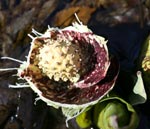
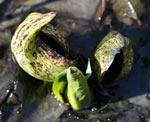 Symplocarpus foetidus, Skunk Cabbage. Leaves open after the plant blooms. Flowers enclosed in a mottled hood-shaped structure called a spathe. Swamps and wet woods. Photo at left with spathe removed and flowers exposed. Common.
Photos: kbarton
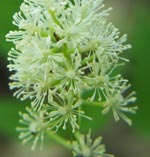
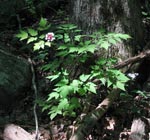 Actaea pachypoda, Doll’s Eyes. Leaves divided, flowers white in a cluster. Fruit of thick-stalked white berries with black centers which accounts for the name Doll’s Eyes. Grows in rich woods. Common.
Photo on left: kbarton
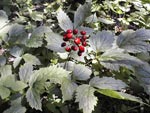 Actaea rubra, Red Baneberry. Leaves and flowers are similar to Doll’s Eyes. Fruits are red berries. Grows in rich woods. Rare.
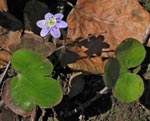 Anemone americana, Hepatica – Leaves are basal and deeply three lobed. Several blue or white flowers arise from the base of the plant. Grows in rich woods. Rare.
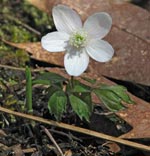 Anemone quinquefolia var. quinquefolia, Wood Anemone. A whorl of three divided leaves halfway up the stem bears a solitary long-stalked white flower of 4-7 petal-like sepals. Grows in woodlands. Common.
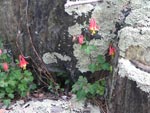 Aquilegia canadensis, Wild Columbine. Compound leaves with drooping scarlet and yellow, spurred flowers. Rocky woods. Common.
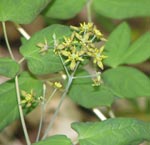
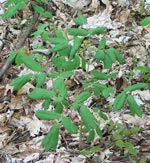 Caulophyllum thalictroides, Blue Cohosh. Divided leaves with yellow-green flowers on a branched stalk. Grows in rich woods. Rare.
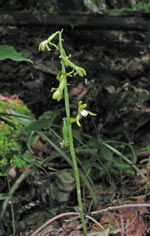 Corallorhiza trifida, Early Coralroot Orchid. Coralroot orchids have a stem with flowers and no leaves. Their nutrients are supplied mainly by soil fungi. This species has yellow flowers with a white lip. Grows in swamps and wet woods. Rare.
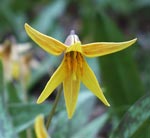
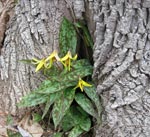 Erythronium americanum ssp. americanum, Trout Lily. Single yellow flower with two oval-shaped mottled leaves. Grows in moist woods. Uncommon.
Photo on left: kbarton
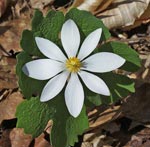
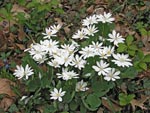 Sanguinaria canadensis, Bloodroot. A solitary lobed leaf with a long-stalked white flower. Rich woods. Rare.
Photo on left: kbarton
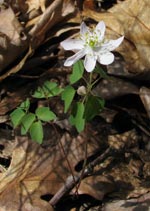 Thalictrum thalictroides, Rue Anemone. A small plant with a whorl of three-lobed leaves beneath dainty white flowers on delicate stalks. Grows in rich woods. Rare.
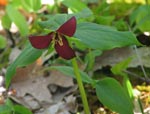 Trillium erectum var. erectum, Purple Trillium. A single maroon flower is subtended by three broadly oval leaves. Rich, moist woods. Rare
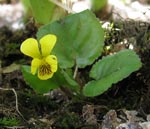 Viola rotundifolia, Stemless Yellow Violet or Yellow Round-leaved Violet. Yellow flowers appear with the scalloped leaves in early spring. The three lower petals have red veins. Grows in rich, moist woods.
