Posted October 17, 2013 from FRU
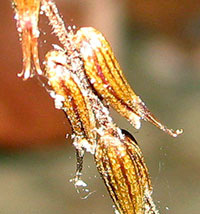
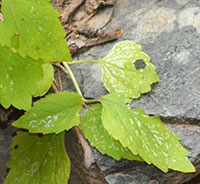 Recently I found a population of Lopseed (Phryma leptostachya) growing in rich woods in Providence County.
The plants usually bloom in July and August and had passed their prime by the time I found them in October.
Lopseed has opposite coarsely-toothed leaves and has a spike-like raceme of pink (or purple) to white flowers with a three lobed lip.
Apparently it is a very uncommon plant in RI although it is not on the rare plant list.
I have inquired of several people familiar with native plants and none of them has seen it growing in RI. If you have seen Lopseed growing in RI please let us know.
Here are a few photos of the plants that I saw. One photo shows the fruiting stalk with the achenes which are contained within the sepals. The flowers are borne on short pedicels at right angle to the stalk and after the flowers are pollinated the pedicels “lop” down and hug the stalk. The achenes occur singly within the fruit.
I am looking forward to see the plants when they bloom next summer.
Below is a link for more information about Lopseed.
http://www.minnesotawildflowers.info/flower/american-lopseed
_________________________________
Posted September 12, 2013 from kb
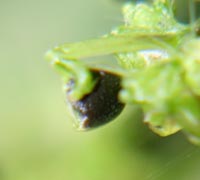
Fran and I were out in Johnston today. We came across Pinesaps (Monotropa hypopithys) in bloom and Zig-zag Goldenrod (Solidago flexicaulis), but the high point was finding Wood Nettle (Laportea canadensis) and Ostrich Fern (Matteuccia struthiopteris).
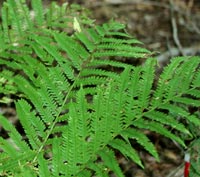
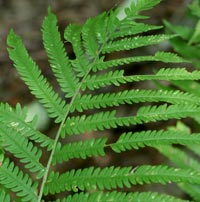
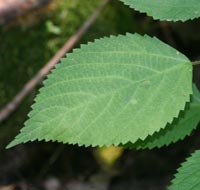
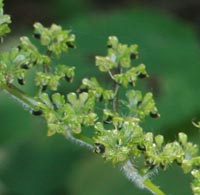
_________________________________
Posted September 11, 2013 from Hope Leeson
Just wanted to let you know that there is a New England Botanical Club
field trip this Saturday in Plymouth, MA, nice coastal plain ponds and pine barrens. Anyone is welcome, meetings are public.
MYLES STANDISH STATE FOREST Field Trip
Sept. 14, 2013, 12:00 noon-4:00 pm.
Meet at the State Forest Headquarters,
194 Cranberry Rd., Carver, MA. (508) 866-2526.
Trip Leaders: Tim Simmons, Irina Kadis, and Bryan Connolly
Saturday Evening Speaker: Tim Simmons - 6:00 pm
"Pine Barrens: Origins, Biodiversity, and Management"
Speaker's Location: 6:00pm - Red barn at State Forest Headquarters, 194 Cranberry Rd, Carver, MA
Field Trip Information
Field Trip runs noon until about 4 PM in
"one of the largest contiguous pitch pine/scrub oak communities north of Long Island. Scattered throughout Myles Standish State Forest are several ecologically significant coastal plain "kettle" ponds."
Dinner break will be 4:00-6:00 pm,
followed by Tim Simmons presentation.
See web site for directions, state forest trail maps,
and information about swimming at College Pond
(Fearing Pond is closed to swimming).
http://www.mass.gov/eea/agencies/dcr/massparks/region-south/myles-standish-state-forest.html
_________________________________
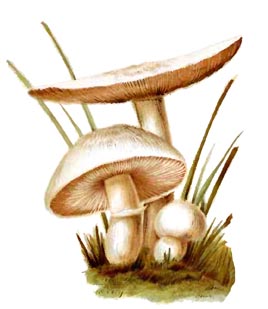
Posted September 8, 2013 for all the Mushroom enthusiasts.
To down a pdf of the poem, click here.
Bill is a mushroom expert,
and Bill is a friend of mine,
He has studied the amanita
and all its ancestral line;
He goes to the fields each autumn
to harvest a dinner treat,
For he knows which are deadly fungi,
and which are the ones to eat.
Bill can talk by the hour on mushrooms
and he laughs at my timid fears,
He is still in the land of the living
and has eaten the things for years ;
He is wise in the lore of the meadow,
the swamp and the dark ravine,
And I'd say, of the mushroom experts,
he's the best that I've ever seen.
If ever I gathered mushrooms
I'd carry them back to Bill
And ask him to look them over
and pick out the ones that kill;
I'd trust to his certain knowledge
and bank on his judgment, too,
For he is a shark on that stuff
and can spiel it right off to you.
Bill knows 'em and loves 'em and eats 'em,
and all through the days of fall
He's out with his little basket
in search of the snowy ball;
And never I doubt his knowledge,
I grant it surpasses mine —
But during the mushroom season
I don't go to Bill's to dine.
—Edgar A. Guest,
The Passing Throng, 1923
_________________________________
Posted September 3, 2013 from DS in Cumberland
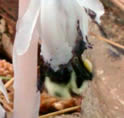 Indian Pipes (Monotropa uniflora) are still blooming. Notice the bumble bee.
_________________________________
Posted August 29, 2013 from FRU
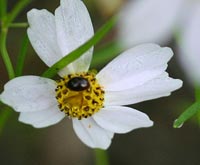 Pink Tickseed (Coreopsis rosea) is listed as globally vulnerable by Nature Serve. It is found in eight states along the eastern seaboard and one Canadian province. It is listed as a plant of concern in RI. It grows in wet sandy soil along the east coast.
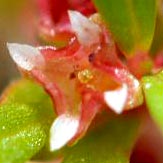
Here is a photo of the tiny white petals on Toothcup (Rotala ramosior). It is listed as State Endangered in RI
_________________________________
Posted August 17, 2013 from FRU
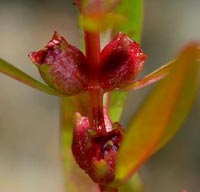
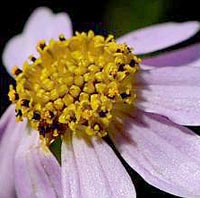
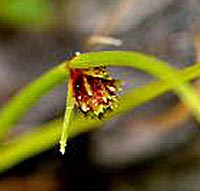
In West Greenwich today a number of rare plants were in bloom; Toothcup (Rotala ramosior), Pink Tickseed (Coreopsis rosea), and Tiny-flowered Sedge (Lipocarpha micrantha). All these plants grow in similar habitats of wet, sandy soil, especially around ponds which drawdown in the late summer.
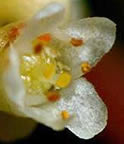
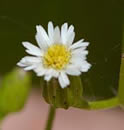
Also found were Collared Dodder (Cuscuta indecora) which is a very uncommon parasitic plant. I also noticed a number of Horseweeds (Erigeron canadensis), a common plant of disturbed places and sandy habitats.
_________________________________
Posted August 15, 2013 from kb
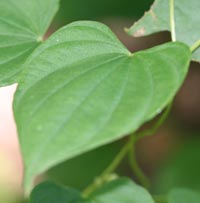
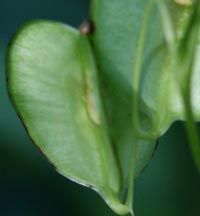
Fran and I were out wandering along the Wood River in Exeter today and came across the seed capsules of Wild Yam (Dioscorea villosa). It was unusual enough that we both took photos and I'm posting a couple. One photo shows the three-parted seed head and the other, leaves of Wild Yam. While we were there, we also saw Cardinal Flower (Lobelia cardinalis), Spotted St. Johnswort (Hypericum punctatum), and Wild Mint (Mentha arvensis).
_________________________________
Posted June, 2013 from kb
At the beginning of May, I started reading "According to Season," 1894, by Mrs. William Starr Dana. Mrs. Dana is also known for the book "How to Know the Wildflowers" and, under the name Frances Theodora Parsons, "How to Know the Ferns." I enjoyed it enough that I thought others might like it. I'm serializing the chapters to match the seasons/months. You can find the link to the webpage is at the top of the Items of Interest column on the home page or you can click here to go directly to it. The publication schedule is as follows:
Preface—June
Introductory—June
April and Early May—June
May and Early June—June
June and Early July—June
Midsummer—July
Early August—August
Late August and Early September—September
Autumn—October
_________________________________
Posted April 27, 2013 from ABW
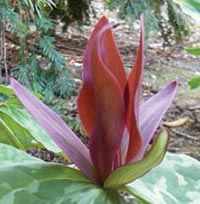
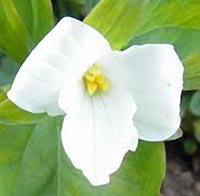
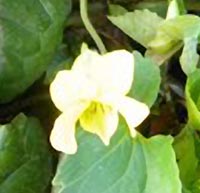
Toadshade (Trillium sessile) grows well in my garden. Contrast that with the Trillium grandiflorum which barely holds on. Smooth Yellow Violet (Viola pensylvanica) holds its own against Ajuga.
_________________________________
Posted April 17, 2013 from kb
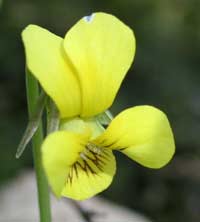
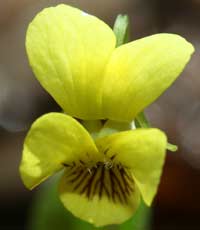
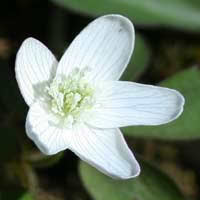
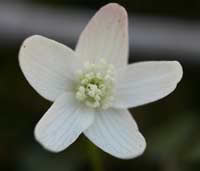
Spring has finally sprung (hopefully). Fran and I were out at Parker Woodland today and found Round-leaved Yellow Violets (Viola rotundifolia) and Wood Anemones (Anemone quinquefolia) in bloom. Viola rotundifolia is listed in Rare native Plants of RI as State Threatened.
_________________________________
Posted March 30, 2013 from ABW
Signs of Spring in the sunny south
Here on Aquidneck Island and mainland towns on the coast, we are a littlle cooler than inland at this time of year. Still I knew there must be something to see! In Warren at Touissett, sedges in wetland were showing growth and I noticed a congested cluster of Marsh Marigold leaves. But, at Colt Park in Bristol--hoorah! Skunk Cabbage flowering and spears of furled green leaves. Spicebush buds still closed, but swelling; ditto on Catbriar. Invasive Honeysuckle leaves opening; ditto Multi-flora Rose. Stay tuned.
_________________________________
Posted February 3, 2013
I usually do this year end round-up in January, but between my husband retiring just before Christmas, the Holidays, and a virus that knocked me down for three weeks, I just couldn’t manage it. So, on the theory “better late than never”, here’s the update on the website.
This is the fourth anniversary of our website. We’ve been very pleased with the support we’ve received and have committed to another three years with our broadband provider.
This past year we had 27,864 visitors (from 54 countries) with a total of 67372 visitors since we started. Since March, we’ve averaged over 70 visitors a day and for the last three months of 2012, we had over 80 visitors a day with December averaging 90.
This year, we hope to add RI Fern Allies. The Common Names pdf is being turned into a web page for ease in access and improved search capability. There may be a few other things developing, but as always “Man proposes, God disposes,” so check in once in a while to see what’s happening.
And once again, thank you again to Anne Wagner, Garry Plunkett, Doug McGrady, and new contributor Nancy Fullerton for their additions to the News page. The folks at the Rhode Island Wild Plant Society have been kind enough to add a link on their monthly e-newsletter to our mystery plant. Thank you, RIWPS! Thanks to everyone who has participated in the mystery plant game
As always, we welcome questions, comments, and involvement .
Fran and Kathy