Posted October 24, 2012 from DMcG
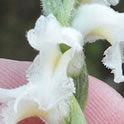
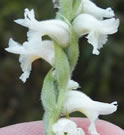
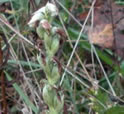
RI has several species of Ladies’ Tresses orchid - some are rare, but most are common. The Yellow Ladies’ Tresses (Spiranthes ochroleuca) is a rare “common” plant. I found a patch in Johnston along a utility line right-of-way — a first for me. There were about 20 plants, but only one was in flower. This species distinguishes itself from our other Spiranthes by the yellow shading in the throat and under the chin.
_________________________________
Posted October 14, 2012 from DMcG
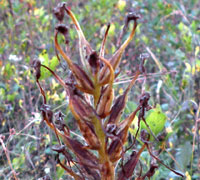
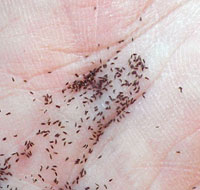
Inspired by the recent post from KB, I took a closer look at a White-fringed Orchid (Platanthera blephariglottis) the other day. The one in this photo is part of large patch in Warwick. It’s about two feet tall and setting seed. I opened a seed capsule in my palm and saw that it contained what looked like a couple thousand tiny seeds. This plant has about 30 capsules holding a combined total of perhaps 60,000 seeds. This patch has about 100 plants, thus 6,000,000 seeds. It’s amazing there are not more plants.
_________________________________
Posted October 14, 2012 from DMcG
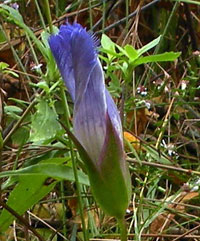
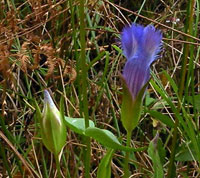
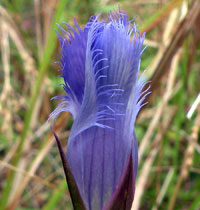
Recently, under some power lines in Johnston, I came upon a patch of Fringed Gentian (Gentianopsis crinita). I counted 33 plants on the edge of a Cattail marsh. These late-bloomers are not rare in New England, but I believe RI has only one other population. I did not see any that were fully open, but I was delighted to see them as they were. Coincidently, a quarter-mile further down the power lines is a large population of Bottle Gentian (Gentiana clausa) that was reported here last year.
_________________________________
Posted October 3, 2012 from kb
As some of you may know, there's a stand of Cypripedium parviflorum var. pubescens (Yellow Ladyslipper) in Cumberland. For quite a few years now, I've been caging this stand in the spring to protect them from deer browse and uncaging them in the fall so they can get covered with leaves for protection in winter. This year, when I went to uncage them, I was thrilled to discover there were three mature seed heads. This is a first for them and I just had to share it. Sorry I didn't have any photos to share.
_________________________________
Posted September 20, 2012 from NF
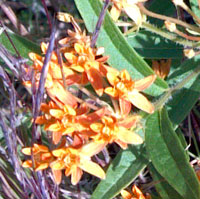 Just wanted to share a photo of Butterflyweed (Asclepias tuberosa) I found at Big River on September 14, while walking with a friend. I looked around for more plants, but found only this one. It was the highlight of my walk today!
Note: This is late for butterflyweed tobe blooming.—kb
_________________________________
Posted August 18, 2012 from FRU
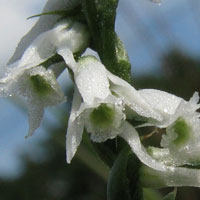 Northern Slender Ladies Tresses orchid is listed on the RI Rare Plant List. It grows in fields and cemeteries which have not been closely mowed. Its botanical name is Spiranthes lacera var. lacera. The green-colored lip is the key in identifying Spiranthes lacera. There is another variety of Spiranthes lacera named var. gracilis. This plant was recently found in West Greenwich.
_________________________________
Posted August 8, 2012 from FRU
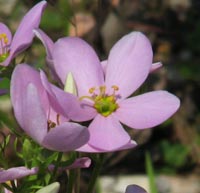
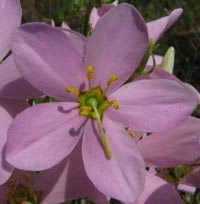
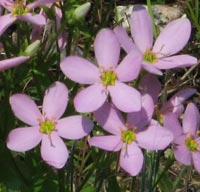 While walking down a gravel trail in Charlestown recently, I came upon what looked like a bouquet of beautiful pink flowers. I thought I was seeing a mirage in this desert-like environment. It was no mirage, but rather a plant of Sabatia angularis in full bloom. Its common name is Rose Gentian and the flowers look very much like Plymouth Gentian with fewer petals.
Sabatia anngularis is listed in Flora Novae Angliae as naturalized in Connecticut and Massachusetts. Connecticut Botanical Society has it listed as native.
_________________________________
Posted August 7, 2012 from GP
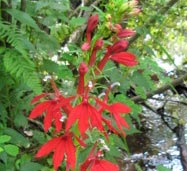
Came across a beautiful stand of Cardinal Flower (Lobelia cardinalis). We get some every year along Sin and Flesh Brook.
_________________________________
Posted August 3, 2012 from ABW
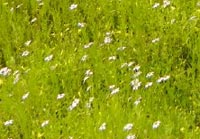
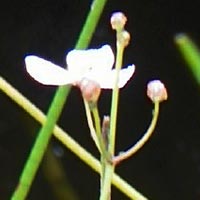
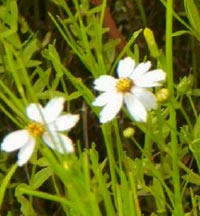 I went to Phelps Pond in East Greenwich the other day. The scene at the pond was fairly typical of late summer, with a severe draw-down, leaving the usual 3 or 4 very small pools. The exposed soils were densely covered with Coreopsis rosea (Rose Coreopsis) in bloom and also Golden pert. Also frequent was an Aster--rather dense, small, white flowers with crowded small lanceolate leaves in the inflorescence. The phyllaries have tapered green centers bordered by white and the closest I can come is Symphiotrichum lanceolatum. Here and there a nut-sedge look-alike was in flower and I didn't bother to take a sample or study it. In the pond area I did not spot either Lipocarpha, nor Rotala.
That brings me to other parts of the area. Chrysopsis (Golden Aster) was blooming near the entry path from the corner of parking lot, but there were so many fewer plants of that and Stiff-leaved Aster than in the past. (I haven't been there in about 2 years.) Continuing westward on that path and then on the right where we often find Rotala, was Orange grass, Pinweed, Euthamia (Goldenrod), Coreopsis rosea, and a dried up, very fine-stemmed Eriocaulon (Pipewort) were evident--no Toothcup. Walking on towards the open wet meadow, Cranberry was thriving, some Wool Grass, some Golden pert, some Coeopsis. There was no standing water anywhere and only an occasional soft, plushy mud. No Rotala, not even in the ruts. Hardhack was in flower here and there and very slender Horseweeds were plentiful. Autumn Olive fruits looked dessicated, but Buckthorn had juicy fruits. No Swamp Milkweed and I've totally given up even looking for Blephs (Platanthera blephariglottis or White Fringed Orchid) anymore. A few Joe-Pye weed in bloom. Along the wooded trail on the west side of the pond, Lysimachia ciliata (Fringed Loosestrife) was blooming. I did not venture into the upland meadow or woodland bordering the highway. On my way home I made the trek to the shore of Rome Point to look for Honkenya (Seabeach Sandwort)
, but found no sign of it. The weather was nice--overcast and cool, but, no flies and only occasional mosquitoes.
_________________________________
Posted June 4, 2012 from kb
 We have received word that Betty Allen has passed away. Betty was a personal friend and will be missed by us. She was an enthusiastic naturalist, full of curiosity and interested in everything. A great trail companion, she never became disturbed with any set backs or disarrangement of plans. An early supporter of this web site, Betty regularly sent in her guesses as to the mystery plant’s identification. Betty served as the Education Committee Chairman for RIWPS.
Our heart-felt sympathy goes out to her family and friends.
_________________________________
Posted June 4, 2012 from kb
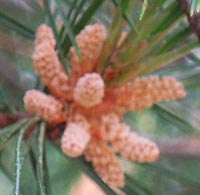
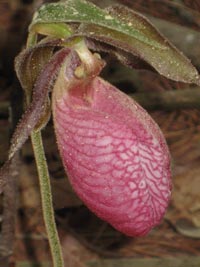
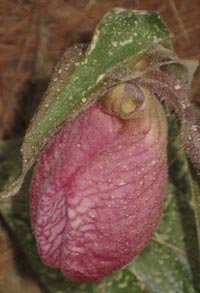
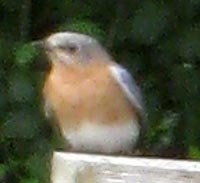 Last Wednesday, I was out with friends at the New Dawn Earth Center in Cumberland looking for Pink Ladyslippers. It was a bit late in the season, but we found some. One of the most amazing things about the woods that day was the White Pine pollen. The ground and plants (and shoes) were liberally covered with it. In the Pink Ladyslipper photos, the blossoms are heavily dusted with pollen. The photo at left shows the male pollen cones. We were also lucky enough to watch the resident Bluebirds. Thanks to NAW for the photos
_________________________________
Posted June 3, 2012 from kb
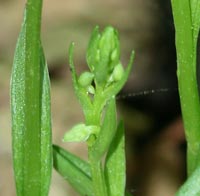
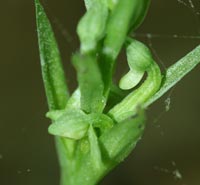
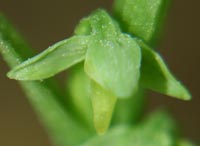
On Friday, June 1,Fran and I were exploring in Scituate and found 24 plants of Northern Green Orchid (Platanthera aquilonis). We also saw Actaea pachypoda), Nodding Trillium (Trillium cernuum), Carrion Flower (Smilax herbacea), Whorled Aster (Oclemena acuminata) and Staghorn Clubmoss (Lycopodium clavatum).
_________________________________
Posted May 13, 2012 from kb
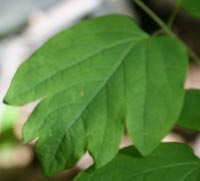
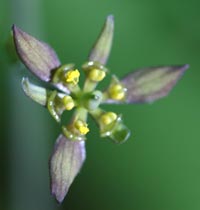
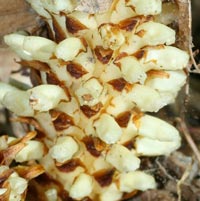
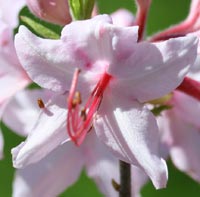
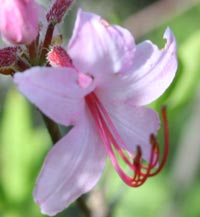
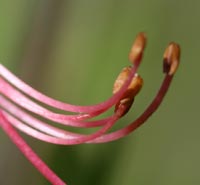
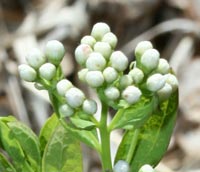
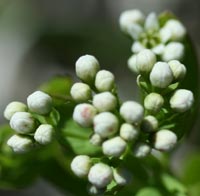
On Friday, May 11, I found Blue Cohosh (Caulophyllum thalictroides) and Squawroot (Conopholis americana) just coming into bloom in a woods in Cumberland. Along an adjacent power line, I found Early Azalea (Rhododendron prinophyllum.) in full bloom and Bastard Toadflax (Comandra umbellata) just starting.
_________________________________
Posted May 3, 2012 from kb
I was walking along the Bike Path in southern Lincoln yesterday and along the embankment of the Blackstone Canal came across One-flowered Cancer-root (Orobanche uniflora) in bloom. This is very early.
Usually, I don't see it until mid-May and in the case of a cold spring sometime
mid to late June. It is a parasitic plant with no leaves, living completely underground and can only be found when it sends up its flower stalks.
For more information, go to
US Forest Service Celebrating Wildflowers
Plant of the Week
For photos, go to:
http://www.ct-botanical-society.org/galleries/orobancheunif.html
_________________________________
Posted May 1, 2012 from FRU
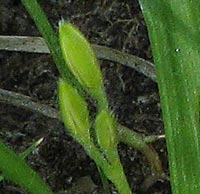
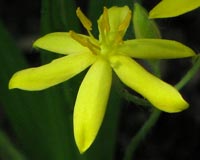
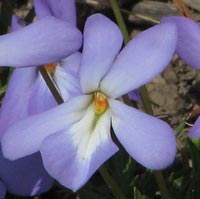
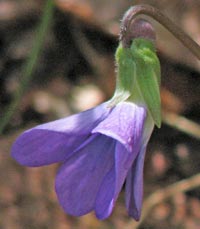
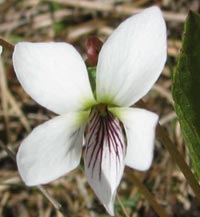
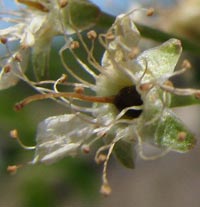
While Bloodroot, Golden Saxifrage, and Hepatica have mostly gone by, there are many Rhode Island wildflowers still in bloom. Here are some of the plants I have seen in bloom recently;Yellow Stargrass, Birdfoot Violet, Palmate-leaved Violet, Lance-leaved Violet, Pin Cherry, Wood Anemone, Dwarf Ginseng, Pennsylvania Bittercress, Common Blue Violet, Northern White Violet, Sweet White Violet, Wild Strawberry, Blueberry, Bastard Toadflax, and Flowering Dogwood.
_________________________________
Posted April 27, 2012 from FRU
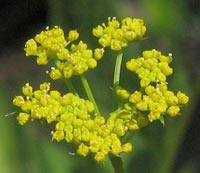
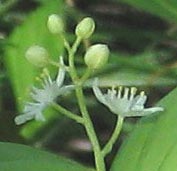
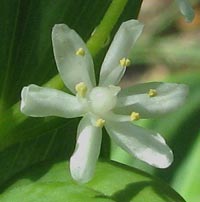
Yesterday, Fran revisited the place in Cumberland we went to on Wednesday and discovered Golden Alexanders (Zizia aurea) and Starry False Solomon's Seal (Maianthemum stellatum).
_________________________________
Posted April 25, 2012 from KB
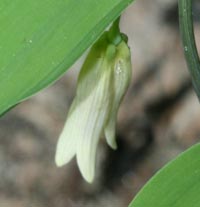
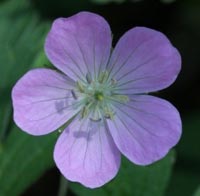
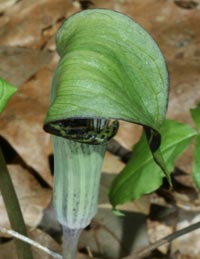
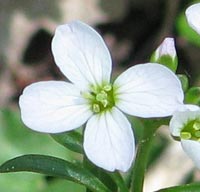 Fran and I were wandering the banks of the mighty Blackstone in Cumberland yesterday and came across Cuckoo Flower, Bellwort, Wild Geranium and Jack-in-the-Pulpits in bloom.
_________________________________
Posted April 4, 2012 from KB in Lincoln
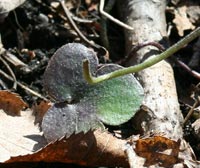
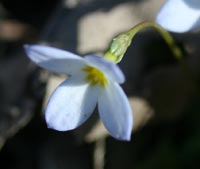
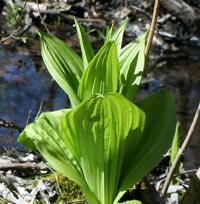
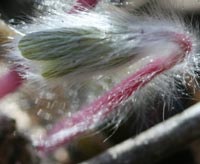 Hey, Gang, the Hepatica is in bud at Limerock! Since things seem to be running early, I decided to check out what was happening at the Limerock Preserve yesterday, I found Hepatica up and budded, Bluets in bloom, Columbine looking perky and Rock Polypody sending up its new shoots. I also found a few Wind Anemones up, but I didn't see any buds or flowers. I later took a walk at the Handy Pond Preserve. I found False Hellebore up and running and more Bluets in blooms. Honewort was also sprouting up.
_________________________________
Posted March 30, 2012 from KB
The Yellow Ladyslippers in Cumberland are beginning to come up. I counted 8 sprouts today and caged the plants to protect them from deer. This is about two weeks earlier than I usually do it.
Posted March 3, 2012 from ABW
Pussy Willow buds are just breaking in Tiverton industrial Park revealing the fuzzy white flowers.
Posted January 1, 2012
Well, we’ve completed the third year of sponsoring this site. The response continues to be positive and the number of people interacting with it has continued to grow.
Since we’ve started, we had over 39,000 visitors and, in the past year, over 18,500. We averaged over forty visitors a day this year. We’ve had hits from 71 countries not including the U.S. Last year we mentioned all the hits we had from Russia. This trend continued this year, with over 7100 hits from the Russian Federation. And we still have no clue why.
We're planning some new articles, but at this time nothing is cast in stone. Fran is planning a new Amateur Botanist article and I'm working on a project about common plant names. So, rather than be specific about publication names and dates, we'll just suggest you check in once in a while to see what's happening.
Thank you again to Anne Wagner, Garry Plunkett and Doug McGrady for their contributions to the News page. And thanks to Don Lubin for his contributions to and support of the RI Ferns article we published last spring. Our thanks to everyone who has participated in the monthly Mystery plant game. We’ve added a monthly word search game. We’re not sure if we’ll keep it. It will depend on the response.
As always, we welcome feed back and contributions.
Fran and Kathy