Posted October 22, 2011 from FRU
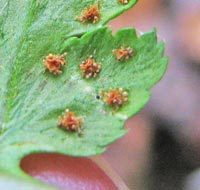
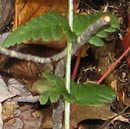
I recently found several Clinton's Wood Ferns growing in very wet soil in sedge tussocks in West Greenwich, RI. Clinton's Wood Fern originated as a naturally occurring hybrid of Crested Wood Fern (D. cristata) and Goldie's Fern (D. goldiana). The Clinton's Wood Ferns that I observed bore a remarkable resemblance to Crested Wood Fern. Clinton's differs from Crested in a few characteristics; the pinnae are longer and more narrowly triangular than in Crested. Also, at least in the sterile fronds of Clinton's, the blades are more abruptly narrowed at the tip, similar to its Goldie’s Fern parent. Both ferns have separate fertile and sterile fronds and in both cases, the sterile fronds are evergreen and the fertile fronds are not.
Here are some photos of
Clinton’s Wood Fern taken in West Greenwich, RI
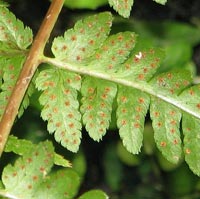
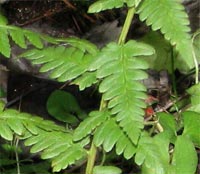
and Crested Wood Fern
taken in Cumberland, RI.
_________________________________
Posted September 17, 2011 from FRU
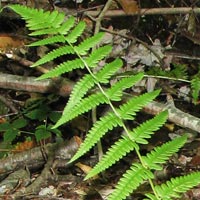
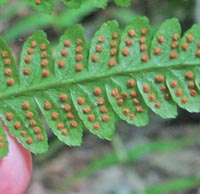 I went to Limerock and found two plants of Dryopteris x slossonae. Dryopteris x slossonae, Slosson’s
Wood Fern, is a rare hybrid of Dryopteris cristata and Dryopteris marginalis. This hybrid exhibits characteristics intermediate between both parents. Its sori, like its marginalis parent are close to the margins of the pinnules and, as in cristata, the lower pinnae or leaflets are triangular-shaped and the pinnae are spaced more widely apart on the rachis. Two of these Wood Fern hybrids were found growing in a very wet area in Lincoln, RI, a habitat which is more consistent with its Crested Wood Fern parent than its other parent, Marginal Wood Fern.
_________________________________
Posted September 16, 2011 from DMcG
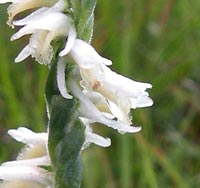
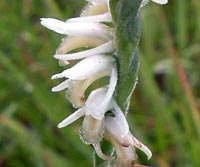 Rhode Island has seven species of Spiranthes (Ladie’s-tresses), but I never saw a rare one until last month. I was exploring a field of little blue stem in the Big River Management Area. I noticed a Spiranthes with a single-rank of flowers spiraling up the stem. Of our seven species two are considered rare. They both have the characteristic of the single-rank spiral. Most of the other species have more flowers without the obvious spiral. There were about 50 Spiranthes vernalis or Spring Ladie’s-tresses.
**************
This year I’ve made a couple trips to a protected property in Foster. What follows are plants I found that are considered rare in Rhode Island.
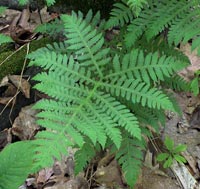 Phegopteris connectilis (Long Beech Fern)
There was a small patch of about 8 plants. These small, compact ferns are always a treat to find. There were a few Maidenhair Ferns nearby.
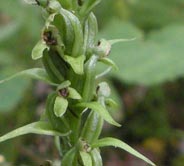 Platanthera flava var. herbiola (Tubercled Orchid)
In a wet area there were 5 of these orchids. They were a little past peak on August 20.
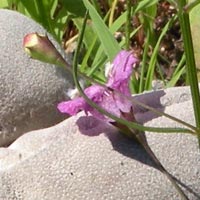
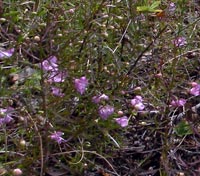 Agalinis tenuifolia (Slender Gerardia)
There were hundreds of these pretty pink flowers running down the middle and sides of a dry, gravel forest road. I’ve seen this plant only once before.
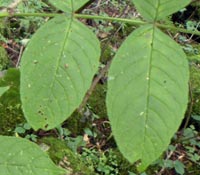 Fraxinus nigra (Black Ash)
Black Ash is very similar to the more common white ash. The most obvious difference is in the leaf. The leaves are compound with 5-9 leaflets on the white and 7-11 on the black. On the white the leaflets are on a small petiole about a ¼” long. On the black there is no petiole at all. I counted about 50 trees in a swampy area. That’s a lot. Furthermore, two of them were about 12” in diameter. That’s about twice the size of any I’ve seen before.
Check out this video to see how Black Ash can be used to produce splints for basket-weaving. The tree has an unusual characteristic that allows the wood to be separated at the growth rings.
http://www.youtube.com/watch?v=F71mCc7xAr0
**************
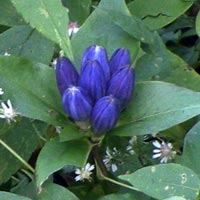
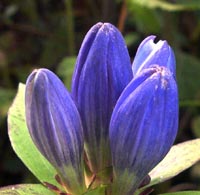
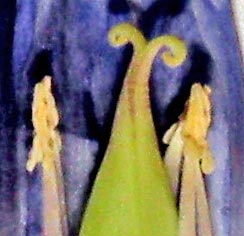
Only twice before have I seen this rare “common” plant in Rhode Island. On September 13 I found a large population of Bottle Gentian (Gentiana clausa) growing on power lines in Johnston. I was thrilled. The flowers in these photos are not in bud, but are at peak bloom. Because these beautiful oddballs do not open fully, it takes a big bee to open it up and pollinate it. See this video:
http://www.youtube.com/watch?v=PvBlWe66qN8
I also included a photo of a flower that I opened to see what’s inside. Five stamens surround a central pistil.
I would like to know if any readers can direct me to other populations of this “common” plant. demcgrady@hotmail.com
**************
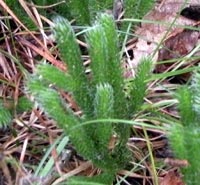
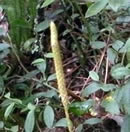 In 2009 this web site mentioned that Lycopodium lagopus (One-cone Clubmoss) had been reported from Rhode Island for the first time. In 2011 another population has been found on conservation land in Coventry. It is a patch about 8x10ft with about 15 strobilus present. The strobilus are the spore-producing “clubs” at the end of a stalk. The plant looks very similar to the more common Lycopodium clavatum (staghorn clubmoss) which almost always has more than one strobilus on each stalk. They are otherwise difficult to tell apart.
For the 2009 report, click here.
_________________________________
Posted September 3, 2011 from kb
Fran and I were wandering around
Cumberland yesterday and found
Corallorhiza odontorhiza (Autumn Cortalroot)
Status: State Endangered
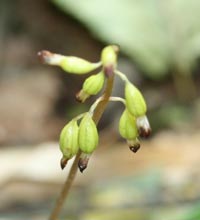
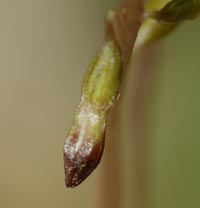
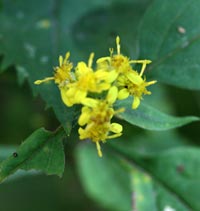
and Solidago flexicaulis (Zig-zag Goldenrod)
Status: State-threatened.
_________________________________
Posted July25, 2011 from kb
Fran e-mailed me a couple of really cool links involving photos of a Silver-spotted Skipper (Epargyreus clarus) fertilizing a Small Purple-fringed Orchid (Platanthera pycodes). You can see the pollen sacs stuck to its proboscis. The photos were taken by Jim Fowler and he has kindly given us permission to put links on our site.
http://www.flickr.com/photos/22032600@N04/5878876539
http://www.flickr.com/photos/22032600@N04/5878876177
We’ve also added an article called “A Few Native Orchids and their Insect Sponsors” excerpted from “My Studio Neighbors” (1898) by William Hamilton Gibson to our reference section for anyone interested in more information on insects and orchid fertilization.
_________________________________
Posted June 30, 2011 from DMcG
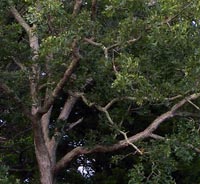
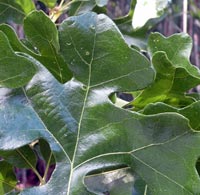
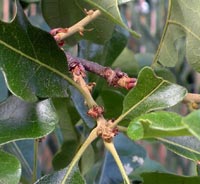
My first clue in the hunt for Post Oak (Quercus stellata) was from this web site. On the Reference page there is a link to “Native Trees of Rhode Island” by Levi Ward Russell. In 1900 he wrote “There is one locality of the ‘post’ oak, near the north shore of Wickford Harbor, the farthest point north for which the tree has been reported.” I thought I should investigate.
The north shore of Wickford Harbor is mainly private, so a naval attack seemed the best tactic. I paddled my kayak from Wilson Park about 700 feet to my first stop at Rabbit Island. Surprisingly, this pretty little island is free of invasives except for a small patch of phragmites. More notable is the fact it is covered with trees – most of them Post Oak. I counted 65 of them ranging from 2 inches to 2 feet in diameter. There were other oaks – White, Black and Scarlet, as well as Red Cedar, Sassafras and Gray Birch. This island was once used by Roger Williams for keeping goats .
I saw more Post Oak on another smaller island to the north, and a handful dotted the mainland shore. I have more exploring to do .
Perhaps this is well known information, but it is new to me. I had never seen a Post Oak before. I was pleased to see such a historical reference is still valid today.
_________________________________
Posted June 30, 2011 from kb
In case you missed it, I want to point out the link to the Virtual Field Trips page on the ARIW home page (or you can click here). These are the creation of Robert Zottoli, Professor Emeritus, Fitchburg University, Fitchburg, MA. He has kindly given us permission to add the links the our website.
_________________________________
Posted June 12, 2011 from GP
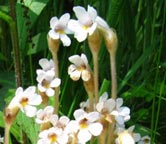 Have you posted one of these? They were at Weetamoo Woods last month. I prefer the Pacific Northwest common name, "Naked Broomrape.
Okay, GP, I'm posting it. For those of you who aren't familiar with this plant, it's One-flowered Cancer-root (Orobanche uniflora). It's parasitic off the roots of Goldenrods and lives completely underground except when it sends up its flowers. In Rhode island, it usually blooms mid-May to mid-June. This is one of my favorite wildflowers.
The quote below has an interesting slant on parasitic plants. You can just picture the vampiric veggies. . .Beware: the Celery stalks at midnight. kb
"A curious, beautiful parasite, fastened on the roots of honest plants from which it draws its nourishment. The ancestors of this species, having deserted the path of rectitude ages ago to live by piracy, gradually lost the use of their leaves, upon which virtuous plants depend as upon a part of their digestive apparatus; they grew smaller and smaller, shrivelled and dried, until now that the one-flowered broom-rape sucks its food, rendered already digestible through another's assimilation, no leaves remain on its brownish scapes. Disuse of any talent in the vegetable kingdom, as in the spiritual, leads to inevitable loss: ' Unto every one which hath shall be given; and from him that hath not, even that he hath shall be taken away.'"
Neltje Blanchand
Nature’s Garden
Garden City, New York
DOUBLEDAY, PAGE & COMPANY, 1920
_________________________________
Posted June 5, 2011 from ABW
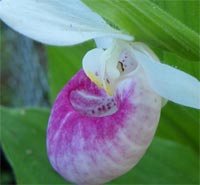
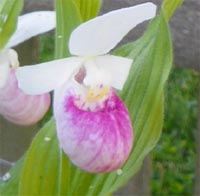 Here are two images of Cypripedium reginae (Showy Lady's-slipper) blooming in my mini-bog where they have resided for 10 years.
Also,lush plants of Lathyrus japonica (Beach Pea)are blooming lustily in Portsmouth, accompanied by the yellow non-native Horned poppy.
_________________________________
Posted April 18, 2011 from kb
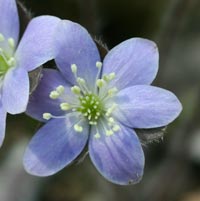
News Flash - Hepatica in bloom
Hepatica (Anemone americana) in bloom at Limerock.
Posted April 14, 2011 from FRU
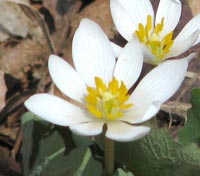
News Flash - Bloodroot in bloom
Bloodroot (Sanguinaria canadensis) in bloom in Cumberland
Posted April 13, 2011 from FRU
Late winter and early spring are ideal times for identifying trees by their twigs and buds.Hickories, Walnuts, Oaks, Hornbeams and many other species are often easier to identify at this time of year than when they are in leaf.
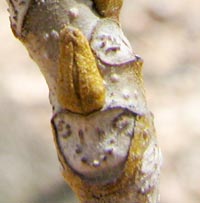 Bitternut Hickory,
Carya cordiformis
Yellow bud scales
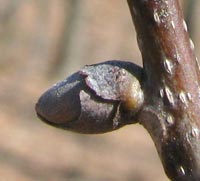 Pignut Hickory,
Carya glabra-
Smooth buds and twigs
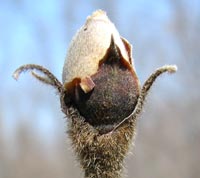 Shagbark Hickory,
Carya ovata
Outer bud scales persistent, twigs very hairy
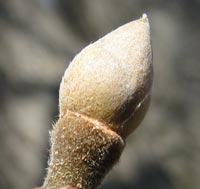 Mockernut Hickory,
Carya tomentosa
Hairy buds, outer bud scales deciduous
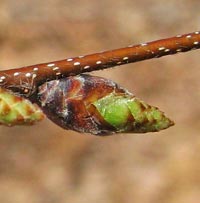 American Hornbeam, Ironwood,
Carpinus caroliniana
Leaf scars very small, twigs with warty lenticels, hairs on twigs appressed
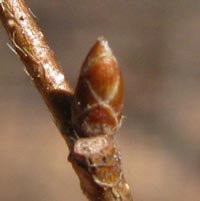 American Hop Hornbeam,
Ostrya virginiana,
Prominent leaf scars beneath brown buds twigs with long protruding hairs
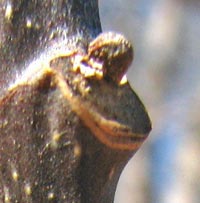 White Ash,
Fraxinus americana
Brown buds, leaf scars notched at top
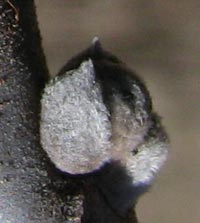 Black Walnut,
Juglans nigra
Gray buds, leaf scar notched at top
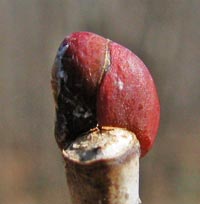 Basswood,
Tilia americana
No terminal bud, buds red and lop-sided
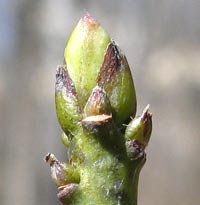 Sassafras,
Sassafra albidum
Green twigs, terminal buds much larger than lateral buds
Posted March 29, 2011 from DMcG
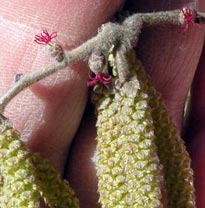
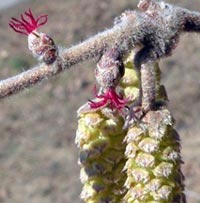 I’ve been looking for blooming hazelnuts for a month now and found some today. These members of the birch family are among the first of our shrubs to flower in the spring. The male catkins are produced in the fall, but don’t open until March. At the same time, the ruby-colored female flowers emerge and await some passing pollen.
The hairs on this young twig indicate this is American Hazelnut (Corylus americana).
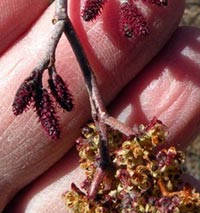
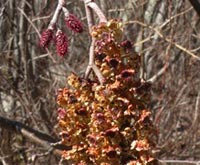 The alder is also in the birch family and, like the hazel, it bears separate male and female flowers in the early spring. The four-inch long male catkins of this Speckled Alder (Alnus incana) caught my eye as I drove down the road.
_________________________________
Posted March 2, 2011 from ABW --Information on the Native Orchid Conference
Native Orchid Conference
Wilmington, DE. Mt. Cuba Center, the mid-Atlantic's premier native plant garden, will sponsor the 2011 Native Orchid Conference. The conference takes place on July 30, 31, 2011 at Mt. Cuba Center in Hockessin, Delaware. Optional field trips, sponsored by the Native Orchid Conference, Inc., will take place on August 1 & 2.
The conference brings orchid enthusiasts from the United States and Canada to hear experts in their field, to share information, and to observe orchids in their native habitat. Post-conference trips will be made to locations in pennsylvania, New Jersey and Delaware. The conference is open to the public and registration information will be available on Mt. Cuba's website, www.mtcubacenter.org, starting March 15.
For further information about the conference, contact NOC 2011 Chair, Phil Oyerly, Greenhouse Manager at Mt. Cuba Center, Tel: 302-239-4244 x 216; e-mail: poyerly@mtcubacenter.org
_________________________________
Posted January 1, 2011
Well, it’s the end of our second year sponsoring this site. The response to among-ri-wildflowers.org has been positive and the number of people interacting with it has continued to grow. As a result, we’ve decided to continue with the site for another two years.
If all goes as planned, this coming year should see the addition of a RI Fern page. The Rare Plants of City Park, Warwick is almost ready and we’re hoping to add some articles on RI Ferns to the reference section.
Since we’ve started, we had over 19,000 visitors and, in the past year, over 12,000. We average over thirty visitors a day. We’ve had hits from 66 countries not including the U.S. And this brings us to the great mystery. In April 2009, we had 6 hits from the Russian Federation. By the end of the year this had grown to 254 hits. But we also had almost 450 from Italy and over 250 from Poland so it really didn’t seem to be a big deal. But the trend continued into 2010, peaking in March with 890 hits. In total for this year, there have been over 5400 hits from the Russian Federation. We have no clue why. . .unless there’s risqué joke in Russian we don’t know about on the site. Seriously, they seem to be looking at orchid photos.
Fran and I thank everyone who has supported our efforts in building and maintaining our site. We especially are grateful to Anne Wagner, Garry Plunkett and Doug McGrady for their contributions to the News page. RIWPS has been generous in giving the site publicity in both RI Wildflora and their e-newsletter and we appreciate the boost they’ve given us. Our thanks to everyone who has participated in the monthly Mystery plant game. Hopefully you’ve had much fun with it as we’ve had.
So keep checking out the site to see what new offerings are being posted. And if you have something you want to add or comment on, e-mail us.
Fran and Kathy
Posted December 19, 2010 from DMcG
I’ve been exploring the hills and ledges in western Foster and Glocester. We have one population of Mountain Spleenwort in the area, so why shouldn’t there be others.
I have not found any yet, however, while looking over some hills in nearby Killingly, I discovered an interesting spot with lot of promise for spring ephemerals.
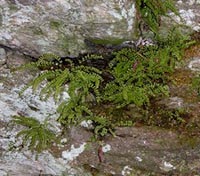
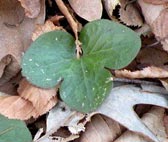 This conservation land has green-stone ledges, seeping hillsides with Sugar Maples, and swaths of Christmas Fern. After looking at some the ledges I saw hundreds of Maidenhair Spleenworts (Asplenium trichomanes) and near the road, Round-lobed Hepatica (Anemone Americana). While these species are not considered rare in Connecticut they are precious among Rhode Island wildflowers. ;-)
_________________________________
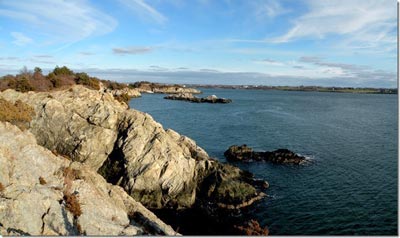
Hunting for plants in the cold weather months is a challenge - there just aren’t that many to be seen. Regardless, “you’ve got to do something”, to quote Chris Nerone. In early December I visited Fort Wetherill in Jamestown. It’s a beautiful spot with high, rocky bluffs covered with Red Cedar and English Oak. I was surprised to see a couple plants still in bloom sheltered in the rocks.
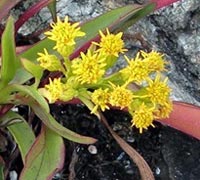
There was a small Seaside Goldenrod (Solidago sempervirens).
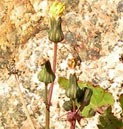
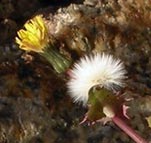
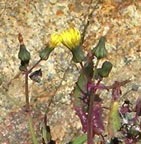
Sonchus asper (Spiny-leaved Sow Thistle) (shown above) was in bloom.
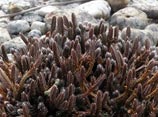
A very small patch of Rock Spikemoss (Selaginella rupestris) was sitting in gravel on a large, flat rock. Reports of sightings were requested from a previous contributor.